
Best Chaukhamba Viewpoints on the Madhyamaheshwar Trek
Published on January 02, 2026 | Updated on September 14, 2026
The Madhyamaheshwar region is known not only for its sacred Panch Kedar temple but also for dramatic Himalayan scenery, with the Chaukhamba massif forming one of the most striking mountain backdrops around the valley.
For travellers specifically looking for the best Chaukhamba view from Madhyamaheshwar, the experience is less about covering a long list of trekking stops and more about being at the right viewpoint at the right time.
The open areas around Madhyamaheshwar Temple provide beautiful mountain views when conditions are clear, while Budha Madmaheshwar is particularly popular among trekkers and photographers because its higher, open setting provides a broader Himalayan panorama.
This guide focuses specifically on where to see Chaukhamba around Madhyamaheshwar, the best time of day for clear views, seasonal visibility, sunrise conditions and practical photography tips.
Where Can You See Chaukhamba from Madhyamaheshwar?
Chaukhamba can be seen from different open sections around the Madhyamaheshwar region when weather and visibility are favourable.
The quality of the view depends on several factors:
- Cloud cover
- Time of day
- Season
- Rainfall
- Mist
- Visibility
- Your exact position around the temple and upper meadows
Three areas are particularly useful for travellers looking for mountain views:
- Buda Madmaheshwar
- Open meadows around Madhyamaheshwar Temple
- Higher open sections above the main temple area
Among these, Buda Madmaheshwar offers one of the most immersive mountain-viewing experiences because of its elevated and relatively open setting.
1. Buda Madmaheshwar: A Prime Chaukhamba Viewpoint
For travellers whose main goal is seeing Chaukhamba, Buda Madmaheshwar should be one of the priority viewpoints.
Located above the main Madhyamaheshwar Temple area, Buda Madmaheshwar is reached by an additional uphill walk from the temple.
The landscape becomes progressively more open as you gain elevation. This creates wider sightlines towards the surrounding Himalayan ranges and gives photographers more freedom to compose the mountains against alpine meadows.
On a clear morning, the snow-covered Chaukhamba massif can dominate the Himalayan skyline.
What makes Buda Madmaheshwar particularly attractive is the combination of:
- Open meadow terrain
- Fewer visual obstructions
- Wide Himalayan panoramas
- Sunrise light
- Quiet surroundings
- Natural foregrounds for photography
Travellers planning the additional climb should use our dedicated Buda Madmaheshwar Complete Guide for route, distance, walking time and visit-planning details.
2. Chaukhamba Views from Madhyamaheshwar Temple
You do not necessarily have to climb higher to appreciate the mountain scenery.
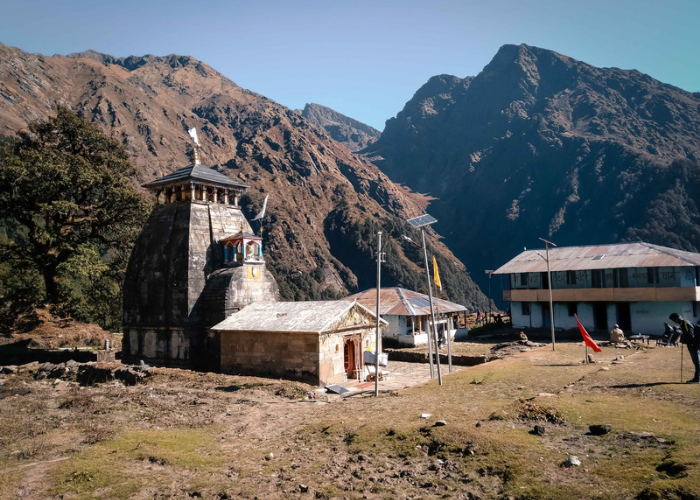
The open surroundings near Madhyamaheshwar Temple can provide impressive Himalayan views whenever visibility is good.
The contrast between:
- stone temple architecture,
- grassy Himalayan slopes,
- surrounding ridges,
- and distant snow-covered peaks
creates a very different visual experience from the higher Buda viewpoint.
This area works particularly well for travellers who:
- do not want an additional uphill climb,
- are short on time,
- want temple-and-mountain photographs,
- or prefer enjoying the scenery close to the temple.
For photography, move carefully around permitted open areas rather than taking every photograph from one fixed position. Even a small change in foreground can create a substantially different composition.
3. Upper Meadow Views Around Madhyamaheshwar
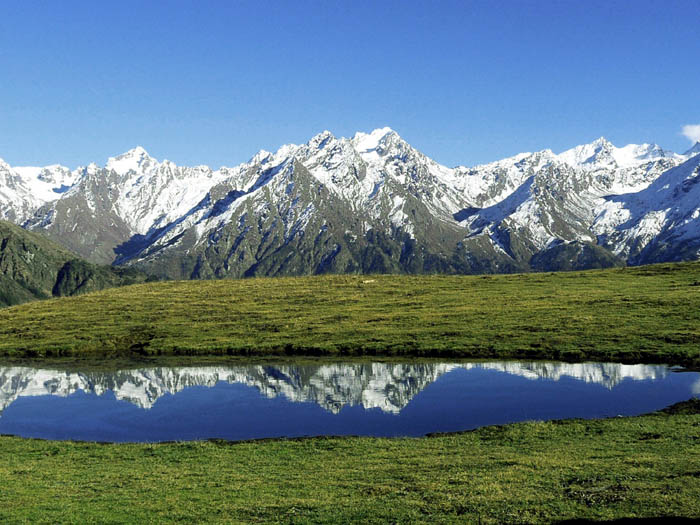
Open meadow sections around and above the main temple area can provide additional perspectives of Chaukhamba.
These are not necessarily formally marked viewpoints. The appeal comes from finding a safe, unobstructed position where the mountain skyline opens up naturally.
Useful viewing locations generally have:
- Open grassland in the foreground
- Limited tree obstruction
- Broad Himalayan sightlines
- Enough distance from buildings for a cleaner composition
Always remain on safe or established walking areas. Mountain terrain can become wet, uneven and slippery after rain.
How Do You Reach the Madhyamaheshwar Chaukhamba Viewpoints?
Travellers approaching Madhyamaheshwar from Rishikesh or Haridwar generally travel through the Garhwal region before reaching the trekking base.
Depending on the road itinerary, travellers may pass Devprayag Sangam before continuing deeper into Uttarakhand towards Rudraprayag and Ukhimath.
Ukhimath acts as an important road base for the Madhyamaheshwar region. From here, travellers continue towards Ransi Village, the principal trekking base for the journey towards the temple.
The trekking approach passes through traditional mountain settlements and forest sections associated with Gaundar Village and Bantoli Village before travellers eventually reach the higher Madhyamaheshwar landscape.
This article intentionally does not reproduce the full trek itinerary because the main purpose here is to help travellers find and photograph the best Chaukhamba views.
If you want transport, stays and the complete organised itinerary in one place, see the Madmaheshwar Tour Package.
Why Is the Chaukhamba View from Buda Madmaheshwar So Popular?
The Chaukhamba massif is one of the defining mountain features of this part of the Garhwal Himalayas.
At Buda Madmaheshwar, its visual impact is strengthened by the surrounding open landscape.
Unlike viewpoints surrounded by roads, hotels or dense construction, the setting here is dominated by:
- Alpine terrain
- Mountain ridges
- Open sky
- Natural vegetation
- Snow-covered Himalayan peaks
This gives photographs a much cleaner and more natural foreground.
During clear sunrise conditions, the upper sections of Chaukhamba can begin catching light while the surrounding valley remains comparatively subdued.
That contrast is one of the main reasons early morning is particularly rewarding.
Best Time of Day to See Chaukhamba
Sunrise and Early Morning
Early morning is generally the strongest viewing window to plan for Chaukhamba.
Mountain visibility can often be better before daytime clouds begin building, although Himalayan weather remains unpredictable and clear views are never guaranteed.
For travellers staying around Madhyamaheshwar Temple, an early start towards Buda Madmaheshwar may provide:
- Softer light
- Better visibility
- Quieter surroundings
- Lower glare
- More dramatic illumination on snow-covered peaks
If sunrise is your priority, check the local sunrise time for your actual travel date rather than relying on one fixed time throughout the season.
Travellers deciding between morning and evening light can also read Sunrise vs Sunset at Madmaheshwar.
Mid-Morning
Mid-morning can still provide excellent mountain views when the sky remains clear.
It is also a practical option for travellers who do not want to start before dawn.
As the day progresses, however, stronger sunlight and cloud development can reduce clarity.
Afternoon
Afternoon visibility is more variable.
Cloud, haze and mist can develop around Himalayan peaks, especially during periods of unstable weather.
This does not mean afternoon views are impossible, but travellers visiting primarily for mountain photography should avoid depending on only one afternoon viewing window.
Evening
Evening can produce attractive landscape light when conditions remain clear.
The visual effect is different from sunrise, with changing shadows and warmer tones across the surrounding landscape.
Best Months for Clear Chaukhamba Views
Visibility can vary from year to year and from one day to another. However, seasonal conditions can help you choose a more suitable period.
Late May to June
Late May and June can provide good opportunities for clear mountain views.
Potential advantages include:
- Longer daylight hours
- Active pilgrimage conditions
- Green Himalayan landscapes
- More stable travel conditions compared with peak monsoon
Cloud can still develop later in the day, making early morning a useful viewing window.
July and August
The monsoon creates an entirely different landscape.
The forests and meadows become intensely green, streams carry more water and the mountains can appear especially dramatic when clouds break.
However, Chaukhamba visibility becomes much less predictable because:
- Clouds can cover the massif
- Rain can reduce visibility
- Mist can form quickly
- Mountain views may disappear for long periods
A spectacular clearing can still happen after rainfall, but travellers should never plan a monsoon journey with the expectation of guaranteed Chaukhamba views.
For detailed seasonal conditions, use our Madhyamaheshwar Weather Guide.
September to October
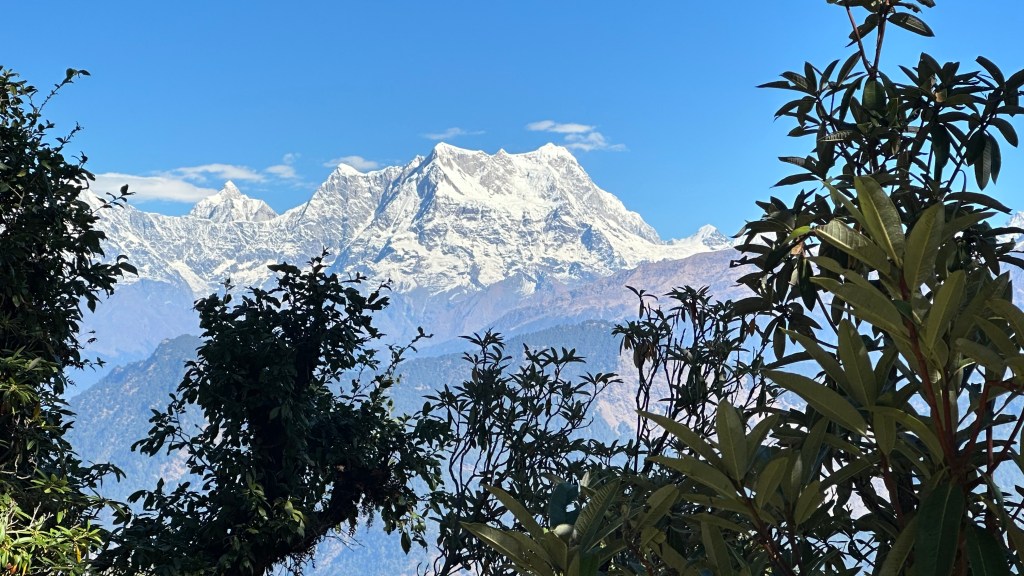
The post-monsoon period is particularly attractive for travellers prioritising mountain scenery.
Potential advantages include:
- Clearer skies
- Improved long-distance visibility
- Cooler trekking temperatures
- Sharper mountain outlines
- Attractive autumn light
For photographers whose main objective is clear Himalayan views, September and October deserve strong consideration.
Can You See Chaukhamba During the Monsoon?
Yes, but visibility is unpredictable.
During the monsoon, Chaukhamba may remain hidden behind clouds for long periods and then suddenly appear when weather conditions change.
Travellers therefore need flexibility.
A practical approach is to:
- Stay near the temple if your itinerary allows
- Check the sky early in the morning
- Avoid relying on one short viewing window
- Give weather priority over a fixed photography schedule
- Avoid exposed areas during severe rain or thunderstorms
Never continue towards a higher viewpoint purely for a photograph when conditions appear unsafe.
Chaukhamba Sunrise at Buda Madmaheshwar
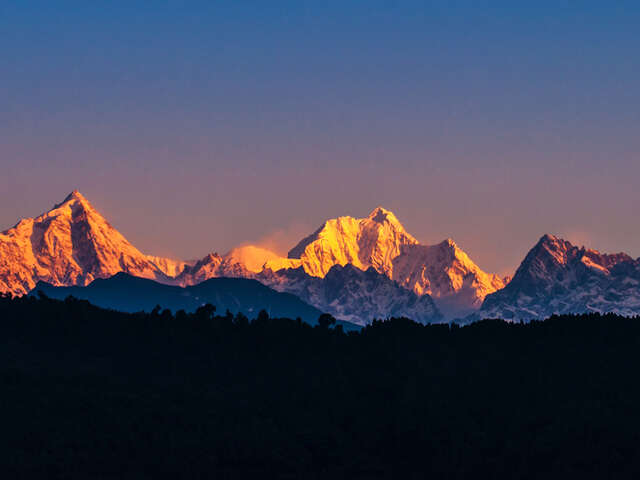
For many visitors, sunrise becomes the highlight of their Buda Madmaheshwar experience.
Before sunrise, the surrounding mountains and meadows can appear muted and cool-toned.
As daylight increases, the higher snow-covered sections of Chaukhamba may begin catching the first light while lower areas remain in shadow.
Because these conditions change quickly, photographers should reach their selected viewing position before the strongest light begins.
Arriving early provides time to:
- Select a composition
- Prepare camera equipment
- Observe cloud movement
- Clean moisture from lenses
- Find a safe position
- Experience the landscape without rushing
The exact sunrise experience always depends on weather and cloud cover.
No Himalayan viewpoint can guarantee a clear sunrise.
Photography Tips for Chaukhamba
Arrive Before the Best Light
Do not wait until the mountain is fully illuminated before setting up.
The transition between pre-sunrise light and early sunlight can produce some of the most interesting photographs.
Include a Foreground
Rather than photographing only the distant mountain, use the surrounding landscape to create depth.
Possible foreground elements include:
- Alpine grass
- Meadow contours
- Temple architecture from permitted areas
- Natural water reflections where safely accessible
- People at a respectful distance
Foreground elements help communicate the scale of the mountains.
Use Both Wide and Tighter Compositions
A wide-angle view works well for showing the relationship between Chaukhamba and the surrounding landscape.
A moderate zoom can isolate:
- Individual mountain faces
- Snow patterns
- Changing light
- Cloud formations
Smartphones can also produce strong results in clear morning conditions.
Avoid excessive digital zoom because it reduces image quality.
For more detailed camera and composition advice, read A Photographer's Guide to Capturing Madhyamaheshwar.

Protect Your Equipment
Mountain conditions can change rapidly.
Keep useful protection accessible, including:
- Camera rain cover
- Lens cloth
- Spare battery
- Secure camera bag
- Waterproof protection for electronics
Cold conditions can also reduce battery performance.
Watch the Snow Highlights
Bright snow can lose detail in strong sunlight.
Check your photographs after the first few exposures and reduce exposure if the brightest areas of the mountain appear completely white.
Photograph the Same Scene More Than Once
Mountain light changes quickly.
Stay with a composition long enough to observe how:
- Clouds
- Sunlight
- Shadows
- Colour
- Mist
change across the massif.
A view that looks ordinary at one moment can look completely different five minutes later.
Chaukhamba Views vs the General Madhyamaheshwar Trek Experience
Travellers visit Madhyamaheshwar for different reasons.
Some come primarily for the sacred Panch Kedar pilgrimage.
Others prioritise:
- Himalayan trekking
- Mountain villages
- Photography
- Wildlife
- Sunrise
- Chaukhamba views
If your primary objective is Chaukhamba, you do not need this page to become another complete Madhyamaheshwar trek guide.
Your viewing-focused journey is better understood as:
Reach Madhyamaheshwar → stay near the temple → check weather → start early → visit Buda Madmaheshwar → experience the Chaukhamba panorama
For broader journey planning, accommodation and travel-day decisions, use the dedicated Madhyamaheshwar Trip Plan.

Is Buda Madmaheshwar Worth the Extra Walk?
For travellers interested in panoramic Himalayan scenery, Buda Madmaheshwar can be one of the most rewarding extensions after reaching the main temple.
The additional climb still requires physical effort.
Before deciding to continue, consider:
- Your fitness
- Weather conditions
- Trail conditions
- Remaining daylight
- Visibility
- How tired you are from the main trek
If conditions are poor or clouds completely cover the mountains, there is no reason to force the climb purely to obtain a photograph.
Safety should always take priority over the view.
Can You See Chaukhamba Without Visiting Buda Madmaheshwar?
Yes.
Chaukhamba and the surrounding Himalayan landscape can be visible from the broader Madhyamaheshwar area when conditions are favourable.
Buda Madmaheshwar is recommended because its higher and more open environment can provide a broader visual perspective, not because it is the only place from which the mountains can be seen.
Travellers who cannot make the additional climb can still enjoy mountain scenery around the main Madhyamaheshwar Temple area.
What Can Block the Chaukhamba View?
The biggest factor is weather.
Cloud Cover
Cloud can hide large sections of the massif even while conditions close to the temple appear relatively clear.
Morning Mist
Mist can temporarily reduce visibility around meadows and lower mountain sections.
Monsoon Rain
Heavy rain and dense cloud significantly reduce long-distance visibility.
Afternoon Cloud Development
A clear morning can become cloudy later in the day.
Severe Mountain Weather
Unexpected changes in weather can affect both visibility and safe access to higher viewing areas.
This is why travellers should treat Chaukhamba as a natural experience rather than a guaranteed sightseeing attraction.
Responsible Viewing and Photography
Madhyamaheshwar is both a sacred pilgrimage landscape and a sensitive Himalayan environment.
When visiting viewpoints:
- Stay on safe and established paths
- Avoid trampling meadow vegetation
- Carry all waste back with you
- Avoid loud music
- Respect temple ceremonies and pilgrims
- Ask permission before photographing local residents closely
- Do not enter restricted areas for photographs
- Avoid drone use unless it is explicitly permitted
Responsible travel protects both the landscape and the experience for future visitors.
Frequently Asked Questions
1. Where is the best Chaukhamba viewpoint in Madhyamaheshwar?
Buda Madmaheshwar is one of the strongest options for panoramic Chaukhamba and Himalayan views because of its open and elevated location above the main temple area.
2. Can I see Chaukhamba from Madhyamaheshwar Temple?
Yes. When visibility is favourable, Himalayan peaks including Chaukhamba can be visible from the broader Madhyamaheshwar area. Buda Madmaheshwar generally provides a wider perspective.
3. Is sunrise or sunset better for Chaukhamba?
Early morning is generally preferable for softer light and potentially clearer mountain visibility. Actual conditions depend on season, cloud cover and weather.
4. Which months are best for Chaukhamba views?
Late May to June and the post-monsoon period from September to October are useful periods to consider. Travellers prioritising clear mountain photography may particularly appreciate post-monsoon conditions.
5. Can Chaukhamba be seen in August?
Yes, but August falls during the monsoon and mountain visibility can be highly unpredictable because of cloud, rain and mist.
6. Do I need to visit Buda Madmaheshwar to see Chaukhamba?
No. Mountain views are possible from the main Madhyamaheshwar area as well. Buda Madmaheshwar is recommended for travellers looking for a more elevated and panoramic setting.
7. Where does the Madhyamaheshwar trek start?
The trekking journey is generally approached from Ransi Village after travelling by road through the Ukhimath side.
8. Which villages are associated with the Madhyamaheshwar trek?
The trekking landscape includes traditional settlements such as Ransi, Gaundar and Bantoli. Travellers interested specifically in these locations can explore the dedicated Gaundar Village guide and Bantoli Village guide.
9. Is Ukhimath important for the Madhyamaheshwar journey?
Yes. Ukhimath is an important road and pilgrimage base connected with the Madhyamaheshwar region.
10. Are organised Madhyamaheshwar packages available?
Yes. Travellers who prefer organised transport, accommodation and trip coordination can check the Madmaheshwar Tour Package for current itinerary and booking details.
11. Are Chaukhamba views guaranteed?
No. Himalayan visibility depends on cloud, rain, mist and rapidly changing weather. Even during favourable travel periods, mountains may occasionally remain hidden.
Plan Your Chaukhamba View Experience
For travellers interested primarily in mountain scenery, Madhyamaheshwar offers much more than a conventional temple trek.
The combination of the sacred Madhyamaheshwar landscape, traditional Garhwal villages, open Himalayan meadows and the Chaukhamba massif creates one of the most memorable visual experiences along the journey.
A typical approach begins through the Garhwal road network around Devprayag and Rudraprayag, continues towards Ukhimath and Ransi Village, and then transitions into the mountain trekking landscape before reaching Madhyamaheshwar.
For the strongest chance of a rewarding Chaukhamba experience:
- Choose a suitable travel season.
- Check weather shortly before your visit.
- Stay near Madhyamaheshwar Temple if your itinerary allows.
- Start early for Buda Madmaheshwar.
- Allow enough time to enjoy the view without rushing.
- Keep expectations flexible because mountain visibility is never guaranteed.
If you prefer to have transport, accommodation and the Madhyamaheshwar journey organised together, explore the Madmaheshwar Tour Package.
For deeper planning, continue with our Buda Madmaheshwar, weather, trip-planning and photography guides rather than turning this page into another broad Madhyamaheshwar trek guide.


