
Budha Madmaheshwar Complete Guide 2026 – Route, Distance, Views & Sunrise
Published on April 02, 2026 | Updated on September 14, 2026
Budha Madmaheshwar — Quick Facts at a Glance
| Detail | Information |
|---|---|
| Also Known As | Budha Madmaheshwar / Vriddha Madmaheshwar / Old Madmaheshwar |
| Altitude | Approx. ~3,580 m (11,745 ft) — ~200 m above main temple |
| Distance from Temple | 2 km one way on foot |
| Trekking Time | 45 minutes to 1 hour (steep ascent) |
| Altitude Gain | ~875 feet (267 m) from the main Madmaheshwar Temple |
| GPS Coordinates | 30°38'1.25"N, 79°12'50.83"E |
| Trek Difficulty | Moderate to Steep — the last 500m is a sharp climb |
| Best Time to Visit | May–June and September–October |
| Ideal Arrival Time | 5:00 AM – 5:30 AM (for sunrise over Chaukhamba) |
| Key Feature | Twin glacial ponds + 360° Himalayan panoramic view |
| Peaks Visible | Chaukhamba I, II, III, IV | Kedarnath Peak | Neelkanth | Meru | Trishul |
| Religious Significance | Ancient shrine of Vriddha (Old) Shiva — older than the main temple |
| Nearest Base | Madmaheshwar Temple Camp / GMVN Guest House |
| Prasad Tradition | Biscuits and chocolates — a charming local custom |
What is Budha Madmaheshwar? (And Why Most Trekkers Miss It)
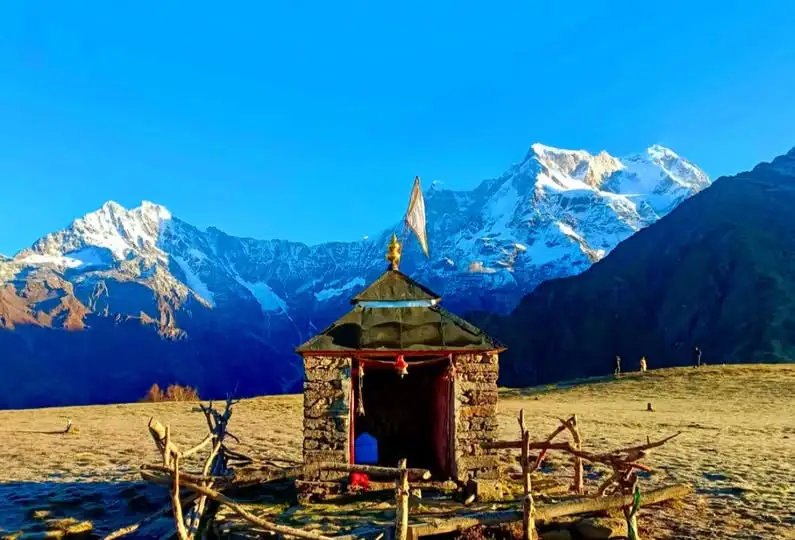
Most trekkers who reach Madhmaheshwar Temple at 3,497 metres are exhausted, relieved, and grateful. They offer prayers, eat dinner, sleep, and return the next morning. And in doing so, they miss the single greatest experience this entire trek has to offer — Budha Madhmaheshwar.
Budha Madmaheshwar, also written as Budha Madmaheshwar or Vriddha Madmaheshwar, is a sacred alpine meadow located exactly 2 km above the main Madmaheshwar Temple. 'Buda' or 'Budha' in Hindi means 'old man,' and this site is so named because the small ancient shrine here is believed to predate the main Madmaheshwar Temple. It is the older, original seat of Shiva — Vriddha Shiva, or Shiva in his ancient form.
Standing at approximately 3,580 metres on the open Madmaheshwar Bugyal, Buda Madmaheshwar offers what experienced Himalayan trekkers consistently describe as one of the finest unobstructed mountain panoramas in all of Uttarakhand. The Chaukhamba massif — four summits of the Gangotri Group, the tallest touching 7,138 metres — fills your entire field of vision. In the early morning light, the phenomenon of first sunlight hitting these snow peaks is something that has no adequate description in any language.
From the Trail: I have stood at Budha Madmaheshwar at 5:15 AM in late May. The temperature was -3°C. There was absolute silence except for the wind. When the sun first touched Chaukhamba I, the entire massif turned from grey to gold in under 90 seconds. Three trekkers around me started crying without warning, without embarrassment. That is the kind of experience Buda Madmaheshwar delivers. — Ashutosh Sharma, TourMyHoliday
Religious & Mythological Significance of Buda Madmaheshwar
To understand Buda Madmaheshwar, you must first understand Madmaheshwar itself. The Madmaheshwar Temple is the 2nd temple in the sacred Panch Kedar circuit — five ancient shrines in the Garhwal Himalayas built by the Pandavas after the Kurukshetra War to seek Lord Shiva's forgiveness. According to the legend, Shiva disguised himself as a bull (Nandi) to avoid the Pandavas. When Bhima caught the bull, it disappeared into the earth and reappeared in five pieces across five different mountain locations:
- Kedarnath — hump (kunda) of the bull
- Tungnath — arms (bahu) of the bull
- Rudranath — face (mukha) of the bull
- Madhmaheshwar — navel and stomach (madhya / nabhi) of the bull
- Kalpeshwar — hair (jata) of the bull
Madmaheshwar, meaning 'the middle Shiva', enshrines a naturally formed black stone Shivlinga shaped like a navel. The temple was built by Bhima, the second Pandava, and is one of the holiest shrines in Uttarakhand.
What Makes Budha Madmaheshwar Spiritually Distinct?
Budha Madmaheshwar — 'Vriddha Madmaheshwar' in Sanskrit — is the original and more ancient seat. The small, blackened stone shrine on the ridge above the main meadow is believed to be the spot where Shiva resides in his Vriddha (ancient/elder) form, before the main temple was constructed. Hindu texts describe Vriddha Shiva as the formless, eternal presence — beyond the constructed shrine, beyond ritual, residing simply in the high mountain air.
For pilgrims on the Panch Kedar Yatra, visiting Budha Madmaheshwar is not optional — it completes the darshan. Many devotees believe that the Madmaheshwar Yatra is incomplete without offering prayers at the ancient hilltop shrine.
The twin ponds at the summit are also considered sacred. The water, fed by glacial snowmelt, is clear enough to mirror the Himalayan peaks above. Devotees take a small amount of this water as prasad. The tradition of offering biscuits and chocolates as prasad at this remote shrine — rather than flowers or sweets — is a charming local custom born from necessity. Whatever trekkers carry up the mountain becomes the offering.
Budha Madmaheshwar Trek Route — Step by Step
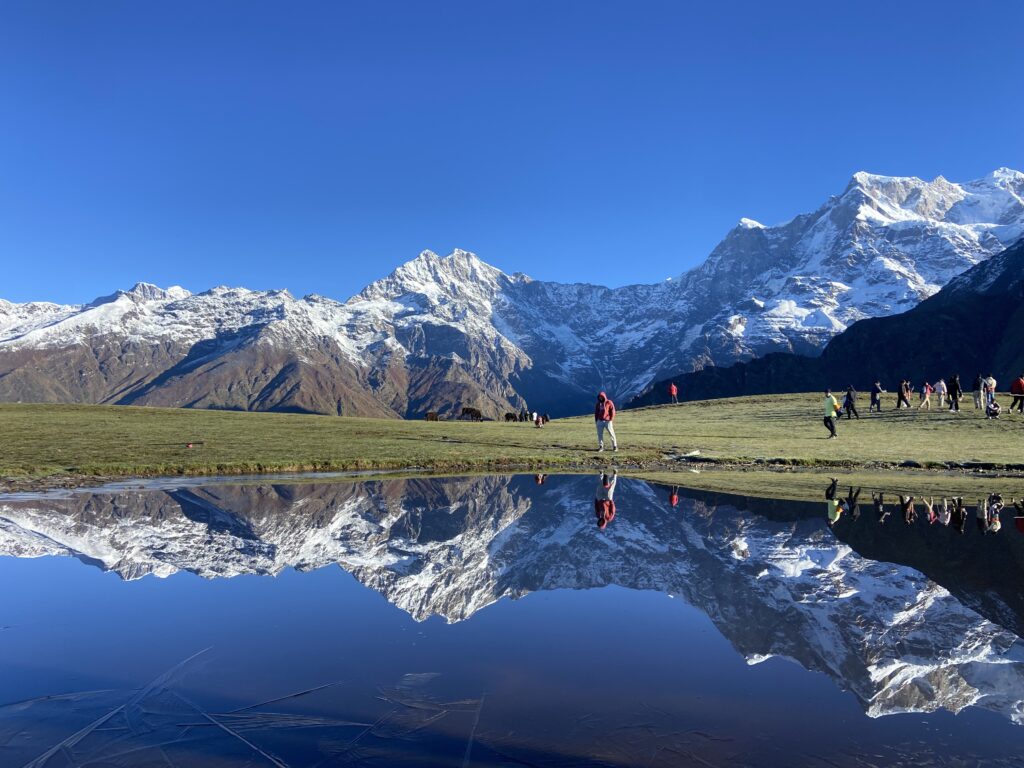
The trail to Budha Madmaheshwar begins from the main Madmaheshwar Temple complex and is short but demanding. Here is an exact, honest, step-by-step description of what you will encounter on this 2 km ascent.
Starting Point — Madmaheshwar Temple Complex (3,497 m)
The trailhead is easy to identify. From the main Madmaheshwar Temple, look to the west and slightly uphill. A well-worn footpath leads out of the temple compound across the open Madmaheshwar Bugyal (alpine meadow). Most nights, fellow trekkers head this way at 4:30 AM with headlamps on — you simply follow the lights.
✅ Pro Tip: Inform your camp host or GMVN caretaker the previous evening that you plan to go to Budha Madmaheshwar for sunrise. They will wake you at 4:00 AM. Do not rely on a phone alarm at 3,500m — altitude affects sleep, and you may not hear it.
The First 500 Metres — Open Meadow (Gradual Climb)
The trail begins across a flat to gently sloping alpine meadow. The grass is short, and the path is clearly marked. In early season (May-June), there may be patches of snow on the meadow — these are manageable and well-trodden. The Himalayan peaks are already visible from this section in clear weather. This is where most trekkers get their first composition photographs of the Chaukhamba range, with the meadow in the foreground.
500m to 1.5km — Entering the Steep Section
After approximately 500 metres of gradual walking, the trail begins to climb more steeply. The path narrows and gains elevation sharply. This is the only genuinely challenging section of the entire Budha Madmaheshwar route. The ground underfoot changes from open grass to loose rocky soil. Trekking poles are strongly recommended here — both for the ascent and especially for the return descent when your legs are tired.
The views begin opening up dramatically from this section. As you gain height above the main temple complex, the Chaukhamba massif begins to dominate the horizon. On a clear day (most days outside the monsoon), you can see all four summits. The ridge you are climbing leads directly toward the massif, creating the illusion of walking toward the mountains.
1.5km to 2km — Final Ridge and Summit Arrival
The final section is the steepest — approximately 200-250 metres of sharp ascent across a narrow rocky ridge. Take your time here, especially if you left before dawn and are navigating by headlamp. The trail is clear and marked, but steep footing requires care. At altitude, your breathing will be noticeably heavier.
At the top, the ridge opens into a small but flat meadow — the Budha Madmaheshwar summit area. The two glacial ponds appear immediately. They are larger than most first-time visitors expect — each roughly 10-15 metres across, perfectly still in the early morning. The ancient Budha Madmaheshwar shrine sits to one side of the ponds, small and blackened with age and incense smoke.

Complete Distance Breakdown
| Segment | Distance | Time | Terrain Type |
|---|---|---|---|
| Madmaheshwar Temple → Meadow Start | 0.2 km | 5 min | Flat, grassy |
| Meadow crossing (gradual incline) | 0.5 km | 15 min | Gentle slope, open |
| Steep ascent begins | 0.8 km | 25 min | Rocky, moderate-steep |
| Final ridge climb | 0.5 km | 15 min | Steep, loose rock |
| Summit — Buda Madmaheshwar | 2.0 km | 60 min | Arrival |
| RETURN: Summit → Temple (descent) | 2.0 km | 40 min | Steep descent, careful |
| TOTAL round trip | 4.0 km | ~2 hrs | Including time at the summit |
The Chaukhamba Sunrise — Why It Hits Differently at Budha Madmaheshwar
There are hundreds of sunrise viewpoints across the Indian Himalayas. From Triund to Chaukori, from Kedarkantha to Chandrashila — all of them are beautiful. So what makes the Budha Madmaheshwar sunrise genuinely different?
Three things combine here that are rare to find together:
- Altitude proximity — At 3,580m, you are closer to the 7,100m Chaukhamba peaks than at almost any other accessible viewpoint in Uttarakhand. The mountains feel close enough to touch.
- Unobstructed view — The open bugyal (meadow) provides a completely clear 270-degree panorama. There are no trees, no ridges, no construction blocking your sightline in any direction.
- Pond reflection — The twin glacial ponds act as perfect mirrors in the stillness of pre-dawn. As the sun rises and the light hits the snow peaks, the entire spectacle is simultaneously happening above you and reflected below you at your feet. This double image — the golden Chaukhamba in the sky and its mirror image in the pond — is what makes photographers and pilgrims equally speechless.
Exact Sunrise Timing Guide by Month
| Month | Approximate Sunrise Time | Depart Temple at | Conditions |
|---|---|---|---|
| May (opening) | 5:50 AM – 6:10 AM | 4:45 AM | Some snow possible, excellent visibility |
| June | 5:30 AM – 5:50 AM | 4:30 AM | Best month — clear skies, green meadow |
| July – August | 5:50 AM – 6:10 AM | 4:45 AM | Monsoon — cloud cover likely, not recommended |
| September | 6:10 AM – 6:30 AM | 5:00 AM | Post-monsoon clarity — outstanding views |
| October | 6:30 AM – 6:45 AM | 5:15 AM | Crystal clear, golden light on snow — stunning |
| November (close) | 7:00 AM – 7:15 AM | 5:45 AM | Cold, possible early snow, temple closing soon |
⚠️ Important: Arrive at Budha Madmaheshwar AT LEAST 30 minutes before sunrise time. The light begins changing on the peaks 20-25 minutes before the sun actually appears above the horizon. Late arrivals miss the most dramatic part — the slow pink-to-gold progression on the Chaukhamba face.
Peaks Visible from Budha Madmaheshwar — Complete Mountain Panorama
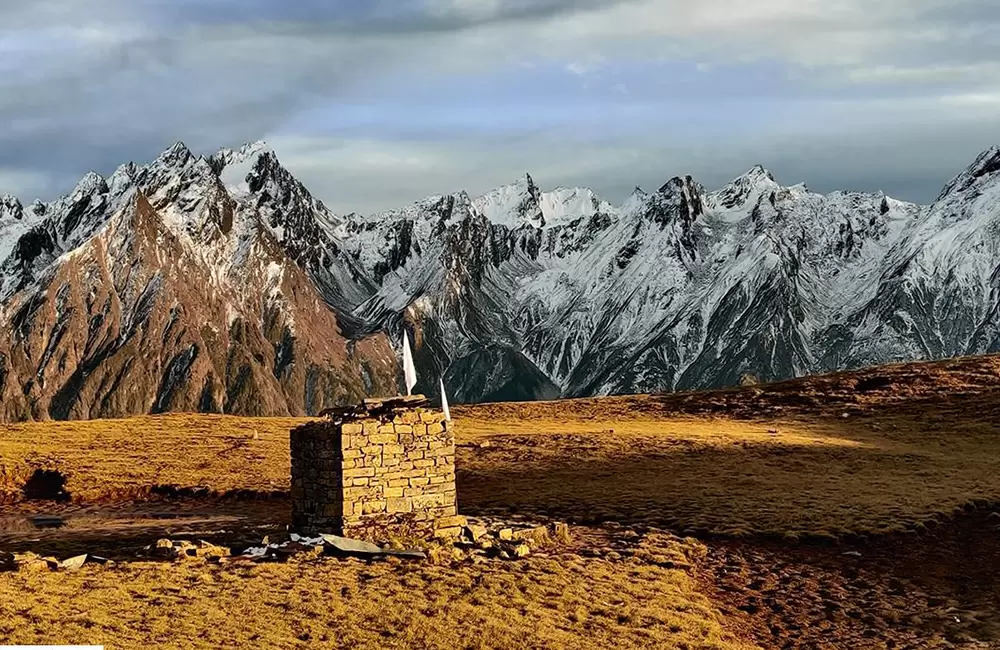
Budha Madmaheshwar is one of the only accessible viewpoints in India where you can see this many major Himalayan peaks simultaneously from a single position. Here is a complete guide to what you will see and in which direction:
| Peak | Altitude | Direction | Significance |
|---|---|---|---|
| Chaukhamba I | 7,138 m | North | Highest of the 4 summits — the main glow point at sunrise |
| Chaukhamba II | 7,068 m | North | Second summit, part of the same massif |
| Chaukhamba III | 6,974 m | North | Third summit, visible on clear days |
| Chaukhamba IV | 6,854 m | North | Southernmost of the four summits |
| Kedarnath Peak | 6,940 m | North-East | The pyramid peak behind Kedarnath Temple |
| Meru Peak | 6,660 m | North | Famous for the “Shark’s Fin” climbing route |
| Neelkanth | 6,597 m | East | The “Queen of Garhwal Himalaya” |
| Trishul | 7,120 m | West | Trident-shaped peak, visible on the clearest days |
| Kedardome | 6,831 m | North-East | Visible behind the Kedarnath ridge |
| Madmaheshwar Bugyal | — | 360° below | The entire green alpine meadow below |
The Chaukhamba Massif is the defining feature of this view. Chaukhamba means 'four pillars' — and from Budha Madmaheshwar, you understand exactly why it was named this. The four summits rise in a near-perfect row, their snows visible year-round, their scale almost impossible to comprehend from this distance.
✅ Pro Tip: Bring a camera with a telephoto lens if you have one. The Chaukhamba summit details — the crevasses, the ice seracs, the cornices — are visible with zoom. Without a telephoto, a wide-angle lens captures the massif's full scale against the meadow below.
Difficulty Level — Honest Assessment
The Budha Madmaheshwar extension is graded Moderate to Steep. Here is the honest breakdown for different types of trekkers:
For Trekkers Who Completed the Main Trek
If you have already trekked from Ransi to Madmaheshwar Temple (16-18 km on Day 2), your legs are already tested, and your lungs are acclimatised to 3,497m. The additional 2 km to Budha Madmaheshwar, while steep, is well within the capacity of anyone who completed Day 2 of the main trek without serious difficulty.
The Steepness Explained
The total elevation gain from the main temple to Budha Madmaheshwar is approximately 267 metres (875 feet) over 2 km. This works out to a 13% average gradient — comparable to the steeper sections of the main Bantoli-to-Temple climb on Day 2. The final 500m section is steeper than this average.
In practice, most trekkers with basic fitness complete the ascent in 50-60 minutes. Those with knee issues or poor cardiovascular fitness should factor in 75-90 minutes and take regular breaks.
Pre-Dawn Conditions — An Additional Factor
Most trekkers make this climb in the dark, between 4:30 AM and 5:30 AM. While the trail is clear, the combination of darkness, cold temperature (-2°C to 5°C typical), altitude, and steep terrain requires:
- A headlamp with fresh batteries — not a phone torch
- Trekking poles — balance on loose rocky sections at night is genuinely tricky
- Warm layers — at least a fleece + down jacket + wind shell over your base layer
- Water bottle — even a short trek at altitude requires hydration
- Fellow trekkers or a guide — solo pre-dawn ascent is not recommended for first-timers
Best Time to Visit Budha Madmaheshwar

Season 1: May – June (Opening Season)
The Madmaheshwar Temple opens in late May 2026 (expected: 21st May). In the first two weeks, there may be residual snow on the meadow and on the trail to Buda Madmaheshwar. This snow adds to the visual drama rather than creating difficulty — the meadow is white, the ponds may still be partially frozen, and the contrast between fresh green shoots and snow creates extraordinary photographs. By June, the meadow is fully green, and the trail is completely clear.
- Temperature at summit: 2°C to 8°C (morning) | 10°C to 16°C (afternoon)
- Visibility: Excellent on most days before noon
- Crowd level: Low to moderate — this is actually a positive
- Special feature: Rhododendrons on the lower trail in May
Season 2: September – October (Post-Monsoon)
This is personally recommended as the best time for the Budha Madmaheshwar sunrise. After the monsoon ends in late August, the atmosphere is crystal-clear — dust and haze washed away by months of rain. The peaks look sharp, close, and vivid. The meadow grass turns golden in October, creating a warm foreground against the white snow peaks. Visibility can exceed 100 km on the clearest October days.
- Temperature at summit: 0°C to 5°C (morning) | 8°C to 14°C (afternoon)
- Visibility: Best of the year — often in the 80-100 km range
- Crowd level: Slightly higher than May-June but still peaceful
- Special feature: Golden grass + snow peaks = best photography conditions
What to Avoid: July – August (Monsoon)
Heavy monsoon cloud cover makes mountain views virtually impossible during July and August. Even if you reach Budha Madmaheshwar, there is a high probability of seeing nothing but clouds. The trail also becomes slippery and dangerous during the monsoon. This extension is not worth attempting during the monsoon.
⚠️ Important: If you are trekking in July-August for the Sawan Maas pilgrimage, skip the Budha Madmaheshwar extension and spend the extra time at the main temple. The views will not be visible during the monsoon.
What to Carry for Budha Madmaheshwar Extension

Since you are trekking to Budha Madmaheshwar as a day extension from the main temple camp, you do not carry your full main pack. Leave your heavy backpack at the camp. Carry a small 10-15L daypack with the following:
| Item | Why Essential | Notes |
|---|---|---|
| Headlamp + fresh batteries | Pre-dawn trail in darkness | Phone torch is NOT sufficient |
| Down jacket/puffer | Temperature at 3,700m pre-dawn is -2°C to 3°C | Non-negotiable |
| Warm hat + gloves | Wind chill at open summit | Fleece or wool |
| Trekking poles | Steep rocky descent is hard on knees without poles | Both poles |
| Water bottle (1L) | Short but altitude demands hydration | Drink 200ml before departing |
| Dry snacks/energy bar | Pre-dawn trek on an empty stomach causes dizziness | Carry a minimum of 2 bars |
| Camera | You will regret not having one here | Charge fully before sleeping |
| Rain poncho (small) | A quick weather change is possible at altitude | Pack it just in case |
| Prasad (biscuits/chocolates) | Local tradition at this shrine | A packet of Good Day works perfectly |
Photography Guide — Getting the Best Shots at Budha Madmaheshwar
Budha Madmaheshwar is a photographer's dream location. Here is a practical shooting guide:
Shot 1: The Classic — Chaukhamba Sunrise
Position yourself facing north, with the twin ponds slightly to your left. Set up your composition with the pond in the foreground and the Chaukhamba massif in the background. Wait. The sequence is: dark blue sky → soft pink on the peaks → amber glow → full gold. The 15 minutes of alpenglow before the sun appears are the most photogenic period. Use a tripod if you have one.
Shot 2: The Reflection
Kneel or lie flat at the pond edge and shoot horizontally across the water surface. On a still morning, the reflection of Chaukhamba in the pond is photographically equal to the real mountain — you get a symmetrical composition of sky-mountains-water-mountains. This is the shot that makes people stop scrolling on Instagram.
Shot 3: Human Scale
Include a fellow trekker in silhouette against the bright sunrise sky. A lone figure on the ridge with Chaukhamba behind them creates an immediate sense of scale that makes viewers feel the vastness of the location.
Shot 4: The Ancient Shrine
The Budha Madmaheshwar shrine — a small, dark, stone structure — photographed against the bright snow peaks creates a powerful juxtaposition of the ancient and the eternal. Best shot in the golden hour light of sunrise.
✅ Pro Tip: Blue hour (20-30 minutes before sunrise) is actually more photogenic than the sunrise itself for mountain photography. The sky is deep blue, the peaks show their full snow detail, and the light is soft without harsh shadows. Do not wait for the golden hour and miss the blue hour.
Beyond Budha Madmaheshwar — Kanchani Tal Extension
For trekkers who want to go further, there is an additional destination 6 km beyond Budha Madmaheshwar — Kanchani Tal, a high-altitude glacial lake at approximately 4,100 metres. This extension is graded Difficult and requires a full day on its own. It is not part of the standard Madmaheshwar package and requires planning.
- Distance from Budha Madmaheshwar: 6 km one way
- Altitude: ~4,100 m
- Difficulty: Difficult — route-finding required
- Best Season: Late June to September only
- Recommendation: Not suitable without a local guide
Trekkers who want to explore the high-altitude route beyond Madmaheshwar can also check our Kanchani Tal Trek from Madmaheshwar guide for route details, distance, difficulty and travel tips.
How to Reach Budha Madmaheshwar — Complete Journey from Delhi
Budha Madmaheshwar is only accessible on foot from the Madmaheshwar Temple. There is no road connection, no ropeway, and no shortcut. To reach Buda Madmaheshwar, you must first complete the main Madmaheshwar trek. Here is the complete journey:
| Stage | Route | Distance / Time | Mode |
|---|---|---|---|
| Delhi → Rishikesh | NH-58 via Muzaffarnagar | 260 km / 6–7 hrs | Car / Bus (overnight) |
| Rishikesh → Ukhimath | Via Devprayag, Srinagar, Rudraprayag | 175 km / 6–7 hrs | Shared jeep / private cab |
| Ukhimath → Ransi Village | Mountain road, narrow | 35 km / 1.5–2 hrs | Shared jeep / private cab |
| Ransi → Bantoli (Day 1 Trek) | Forest trail, riverside | 13 km / 5–6 hrs | Trek |
| Bantoli → Madmaheshwar Temple | Open meadow, steep final climb | 11 km / 4–5 hrs | Trek |
| Madmaheshwar → Buda Madmaheshwar | Open meadow, steep rocky ridge | 2 km / 45–60 min | Trek (Day 3 morning) |
Total journey from Delhi to Buda Madmaheshwar: approximately 3 full days. This is why most trekkers use a structured package — organising transport, accommodation, meals, and guides across 3-4 days is complex to do independently.
Recommended Itinerary Including Budha Madmaheshwar
To properly experience Budha Madmaheshwar, the standard 2N/3D Madmaheshwar package needs to include a proper early morning on Day 3. Here is the recommended itinerary:
Day 0 — Delhi Departure (9:30 PM)
Depart from Akshardham Metro Station, Gate 1. Overnight journey to Rishikesh in a Tempo Traveller / SUV. Estimated arrival: 4:00-5:00 AM.
Day 1 — Rishikesh to Ransi Village
Drive via Devprayag (confluence of Bhagirathi and Alaknanda rivers — 30 min stop), Dhari Devi Temple, Omkareshwar Temple in Ukhimath (evening aarti if timing permits), and then to Ransi Village. Check into a homestay. Dinner included. Early sleep — Day 2 starts at 6 AM.
Day 2 — Ransi to Madmaheshwar Temple (16-17 km Trek)
Start at 6:30 AM from Ransi with a local guide. Trek through Gangi Village, dense Kedarnath Wildlife Sanctuary forests, Gaundhar, and Bantoli. Arrive at Madmaheshwar Temple by 2-3 PM. Offer prayers. Rest. Attend evening aarti (approximately 6-7 PM). Discuss the Buda Madmaheshwar plan with the guide — agree on a 4:30 AM departure. Dinner. Sleep early.
Day 3 — Buda Madmaheshwar Sunrise + Descent to Ransi
- 4:00 AM: Wake up. Warm chai is available. Layer up fully.
- 4:30 AM: Depart Madmaheshwar Temple for Buda Madmaheshwar.
- 5:15-5:30 AM: Arrive at Buda Madmaheshwar. Set up the photography position.
- 5:30-6:15 AM: Sunrise over Chaukhamba. Offer prasad at the ancient shrine. Spend time at ponds.
- 7:00 AM: Begin descent back to Madmaheshwar Temple.
- 7:45 AM: Breakfast at temple camp.
- 9:00 AM: Begin main descent — Madmaheshwar to Ransi (24 km).
- 3:00-4:00 PM: Reach Ransi. Board the vehicle for the Delhi departure.
- Next morning: Arrive in Delhi.
⚠️ Important: The Day 3 morning is non-negotiable for the Buda Madmaheshwar sunrise. Any package or guide that suggests visiting Buda Madmaheshwar in the afternoon should be reconsidered. The views are in the morning. The ponds reflect best in morning light. The afternoon is for descent.
TourMyHoliday — Madmaheshwar Packages Including Budha Madmaheshwar
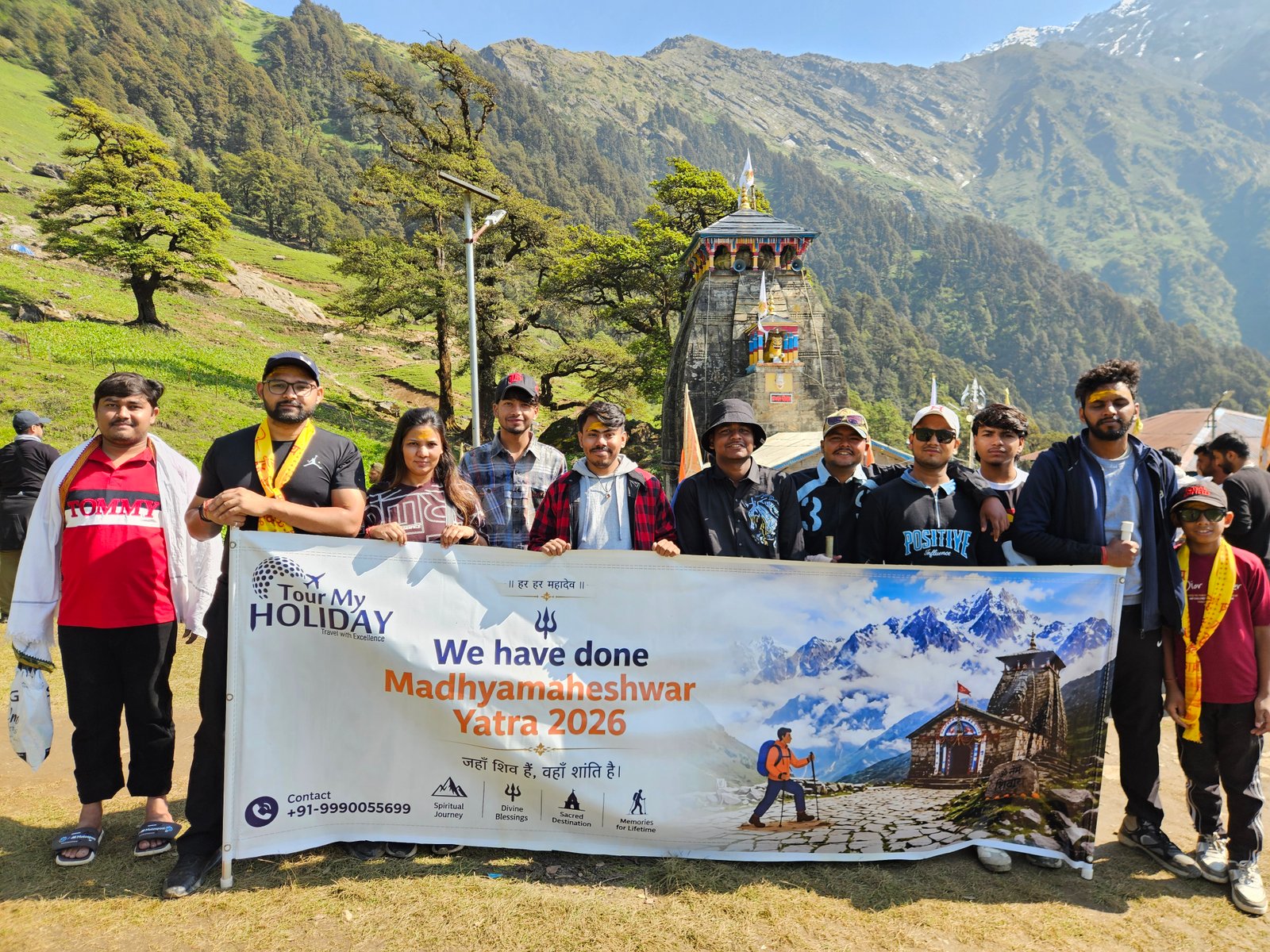
All TourMyHoliday Madmaheshwar packages include the Buda Madmaheshwar extension as part of the standard itinerary. Our trip captains have personally completed this trek dozens of times and know the exact optimal timing for the Buda Madmaheshwar sunrise. We will wake you up.
| Package | Duration | Price | Includes Buda? |
|---|---|---|---|
| Madmaheshwar Tour from Delhi | 2N 3D | ₹7,000/person | Yes — Day 3 sunrise |
| Madmaheshwar Tour from Haridwar | 2N 3D | ₹7,000/person | Yes — Day 3 sunrise |
| Madmaheshwar Tour from Dehradun | 2N 3D | ₹7,000/person | Yes — Day 3 sunrise |
| Madmaheshwar Tour from Rishikesh | 2N 3D | ₹7,000/person | Yes — Day 3 sunrise |
| Madhyamaheshwar Tour from Delhi | 3N 4D | ₹9,000/person | Yes + extra acclimatisation day |
| Madmaheshwar Trek Package | 2N 3D | ₹7,000/person | Yes — complete itinerary |
Plan Your Complete Madmaheshwar Trip — Related Guides
Buda Madmaheshwar is one part of a larger journey. Use these guides to plan every aspect:
- Complete Route → Madmaheshwar Trek Route Guide: Distance, Itinerary & Difficulty 2026
- Temple Dates → Madmaheshwar Temple Opening & Closing Date 2026 + Best Time to Visit
- How to Reach → How to Reach Madmaheshwar — Complete Route Guide
- Accommodation → Hotels in Madhyamaheshwar, Ransi & Gaundar 2026
- Packing Guide → Madmaheshwar Packing List 2026 — Complete Trek Gear Checklist
- Comparison → Madmaheshwar vs Kedarnath Trek: Which Should You Choose in 2026?
- Mistakes to Avoid → Common Mistakes to Avoid During Madhyamaheshwar Trek
- Ground Level Guide → Madhyamaheshwar Temple Trek from Ransi Village
- Full Panch Kedar → Panch Kedar Yatra 2026 — Complete Guide
Frequently Asked Questions — Buda Madmaheshwar
Q1. What is the difference between Madmaheshwar and Buda Madmaheshwar?
Madmaheshwar is the main Panch Kedar temple at 3,497m, built by the Pandavas and enshrining the navel-shaped Shivlinga. Buda Madmaheshwar is the ancient hilltop shrine located 2 km above and approximately 200m higher, believed to predate the main temple. 'Buda' means old — this is the older, more ancient seat of Shiva, offering the famous Chaukhamba view.
Q2. Is Buda Madmaheshwar difficult to reach?
The 2 km trail from Madmaheshwar Temple is rated moderate to steep. The total climb is 267m (875 feet). Any trekker who completed the main Madmaheshwar trek (Day 2) should be able to reach Buda Madmaheshwar without major difficulty. Allow 45-60 minutes for the ascent.
Q3. What is the best time to go to Buda Madmaheshwar?
Leave the main temple camp at 4:30 AM in June, or 5:00 AM in September-October. Arrive at Buda Madmaheshwar 25-30 minutes before official sunrise to witness the full sequence of light on Chaukhamba. September-October offers the best overall conditions — clear skies, no monsoon cloud, and golden autumn light.
Q4. Can I skip Buda Madmaheshwar and still have a good Madmaheshwar experience?
Yes — the main Madmaheshwar Temple, the evening aarti, and the trek itself are all individually significant. But to be honest, Buda Madmaheshwar is the highlight of the entire Madmaheshwar experience. Trekkers who skip it frequently say it is their biggest regret from the trip. The extra 2 km is absolutely worth it.
Q5. Is there accommodation at Buda Madmaheshwar?
No. There is no accommodation, no dhabas, and no facilities at Buda Madmaheshwar — it is a remote mountain shrine. You return to the Madmaheshwar Temple base for breakfast after the sunrise visit. Some experienced trekkers camp in the meadow near Buda Madmaheshwar for a single night — this requires carrying camping gear and is best done with a local guide.
Q6. What is the prasad tradition at Buda Madmaheshwar?
The local tradition is to offer simple packaged food — biscuits and chocolates are the norm. This custom originated because trekkers carrying snacks in their bags would offer whatever they had. A packet of Good Day biscuits or Dairy Milk chocolate is perfectly appropriate. The simplicity of this offering reflects the remote, unpretentious nature of the shrine.
Q7. Are permits required for Buda Madmaheshwar?
No separate permit is required for Buda Madmaheshwar. The standard forest department registration done at Ransi village covers your entire trek, including the Buda Madmaheshwar extension. Carry your original government-issued ID (Aadhaar or equivalent) for the Ransi check post registration.
Q8. Can I do Buda Madmaheshwar as a day trek from Ukhimath?
No. Buda Madmaheshwar is only accessible by completing the full Madmaheshwar trek (Day 1: Ransi to Bantoli, Day 2: Bantoli to Madmaheshwar Temple). There is no direct route. The trek to the main temple alone is 24 km from Ransi — it cannot be done as a day trip.
© 2026 TourMyHoliday | tourmyholiday.com | +91-9990055699 | info@tourmyholiday.com


