Deoria tal trek
Published on August 23, 2025
A Complete Guide with Myths, Legends, and Stories
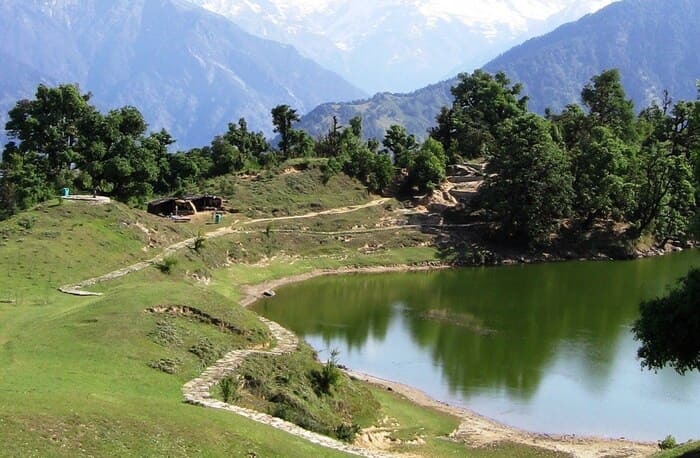
Tucked away at 2,438 meters (7,999 ft) in the lap of the Garhwal Himalayas, Deoria Tal is not just another alpine lake. It is a place where the mountains lean in to whisper ancient stories, where the water is so still that it becomes a perfect mirror for 55 snow-capped peaks, and where every ripple carries a fragment of mythology.
This is the complete story of Deoria Tal — its location, its myths, its untold tales, and why it still feels like a secret even in 2025.
Where Exactly is Deoria Tal?
District: Rudraprayag, Uttarakhand (earlier it fell under Chamoli administrative limits)
Nearest town: Ukhimath (14 km) → Sari village (2.5 km trek starting point)
Altitude: 2,438 m / 7,999 ft
Trek distance: 2.5 km moderate uphill from Sari village (takes 45 min–1.5 hrs depending on fitness)
Best time to visit: March–June and September–December (monsoon turns the trail slippery and leeches appear)

You can see the entire Chaukhamba massif (I, II, III, IV) reflected in the lake on a clear morning — a sight so perfect that photographers call it “the postcard that nature forgot to copyright.”
The Great Myth: Why the Pandavas Came Here
The most famous legend tied to Deoria Tal is from the Mahabharata.
After the Kurukshetra war, the Pandavas were searching for a secluded, pure-water lake where Yudhishthira could perform the final rites and answer the questions of Yaksha (who was actually Lord Yama in disguise). This episode is known as the Yaksha Prashna.
According to Kumaoni and Garhwali folklore, one of the lakes the Pandavas visited during their quest was Deoria Tal (the other major contender being Roopkund, but locals here swear it was Deoria Tal).
When Yaksha asked Yudhishthira the famous 124 questions on dharma, life, and truth, the Pandavas sat on the banks of this very lake. It is believed that the clarity of the water and the silence of the forest helped Yudhishthira give the correct answers that revived his brothers.
Even today, elderly priests in nearby villages narrate that the five large stones on the eastern bank of the lake are the “seats of the five Pandavas.”
The Second Legend: The Demon King Duryodhan and the Broken Reflection
There is a darker, lesser-known Garhwali story.
After the war, it is said that Duryodhan’s soul, still burning with rage, wandered the Himalayas looking for a water body pure enough to dissolve his sins. When he reached Deoria Tal and looked into its mirror-like surface, he saw not his own face but the faces of the 100 Kauravas he had led to death.
Horrified, he struck the water with his mace. That is why, say the locals, the lake is slightly L-shaped — the southern arm was “bent” by Duryodhan’s blow. Even today, on certain windy evenings, villagers claim you can hear a faint metallic clang from under the water.
The Love Story of King Indra and the Apsara Menaka
Another beautiful tale belongs to Indra, king of the gods.
Menaka, the celestial dancer, once displeased Indra and was banished to earth. She chose Deoria Tal as her place of penance because its reflection was so perfect that she could continue practicing her dance by looking at the lake instead of a mirror.
Indra, unable to stay away, would descend every dawn disguised as mist. The rhododendron flowers that bloom crimson around the lake in April–May are said to be drops of Menaka’s anklet-bells that fell during her dance.
When Menaka finally earned forgiveness, Indra lifted her back to heaven, but left behind the tradition that any woman who bathes in Deoria Tal on a full-moon night will be blessed with unmatched beauty and grace.

The Ghost of the British Officer (A Colonial-Era Story)
In 1923, a British forest officer named Captain H. R. Hutchinson camped at Deoria Tal while surveying timber lines. Locals warned him not to light a campfire after sunset — “the devtas don’t like smoke in their mirror.”
The captain laughed, lit a huge bonfire, and took photographs of the reflection with his new Leica camera.
That night, his Garhwali guide woke up to find the captain missing. They found his body the next morning near the water’s edge — eyes wide open, staring into the lake, with an expression of absolute terror. Strangely, his camera was intact, but every single negative was completely black, as if light itself had refused to be captured.
Since then, many campers have reported seeing a man in khaki shorts and a pith helmet walking along the lake at 3 a.m., always stopping at the exact spot where Captain Hutchinson died, staring silently into the water.
The Snake God and the Annual Fair
Every year on Nag Panchami, villagers from Sari, Mastura, and Bheti villages climb up to Deoria Tal carrying milk and flowers. They believe a giant golden serpent (Sheshnaag himself) lives at the bottom of the lake and protects the water.
Pouring milk into the lake is considered equivalent to worshipping Lord Vishnu lying on Sheshnaag in the cosmic ocean. Some years, when the milk is poured, concentric ripples appear from the exact center of the lake even on a windless day — a phenomenon scientists still can’t fully explain (though depth and underwater springs are suspected)

A Quiet Warning from the Locals
“Take nothing but photographs, leave nothing but footprints — and never, ever throw a stone into the lake to ‘see the ripples.’ The devtas are watching.”
Whether you come for the trek, the mythology, the reflection, or the silence, Deoria Tal will give you something no guidebook can describe: a moment when the mountains look straight into your soul — and let you look back.
If you listen carefully at dawn, you might still hear Yudhishthira answering the Yaksha, or Menaka’s anklets, or the faint echo of a British officer’s camera shutter that never clicked.
Deoria Tal keeps its stories alive.
Go, and become a part of one.1sFast
Responsible Tourism at Deoria Tal
Deoria Tal is located in a sensitive Himalayan environment, so responsible travel is important. Carry your waste back with you, avoid using single-use plastic where possible and do not disturb the lake or surrounding vegetation.
Visitors should also respect local customs and religious traditions associated with the area. Keeping the trail and lakeside clean helps preserve Deoria Tal for future travellers and the local communities that depend on tourism.
Frequently Asked Questions About Deoria Tal
1. Where is Deoria Tal located?
Deoria Tal is located in Rudraprayag district of Uttarakhand, and the trek to the lake starts from Sari village. The lake is situated at an altitude of about 2,438 metres.
2. How long is the Deoria Tal trek from Sari village?
The Deoria Tal trek is approximately 2.5 km one way from Sari village. It is an uphill trail and generally takes around 45 minutes to 1.5 hours, depending on walking pace and fitness.
3. What is the altitude of Deoria Tal?
Deoria Tal is situated at approximately 2,438 metres (7,999 feet) above sea level.
4. What is the best time to visit Deoria Tal?
March to June and September to December are generally suitable periods for visiting Deoria Tal. During the monsoon, the trail can become slippery, while winter may bring snow-covered trail conditions.
5. Can beginners do the Deoria Tal trek?
Yes. The short trail from Sari village makes Deoria Tal accessible to many beginners. However, the route is uphill, so visitors should walk at a comfortable pace and take breaks when required.
6. Can Deoria Tal be visited with children and senior citizens?
Families and older travellers can visit Deoria Tal if they are comfortable with the uphill walk. The trail conditions, weather and individual fitness should be considered before starting the trek.
7. Can I reach Deoria Tal by car?
No. Vehicles can reach Sari village, which is the starting point of the trek. From Sari, visitors need to continue towards Deoria Tal on foot.
8. Can I visit Deoria Tal along with Chopta and Tungnath?
Yes. Deoria Tal can be included in a Chopta travel itinerary along with Tungnath and Chandrashila. However, the Deoria Tal trek starts from Sari village, so it is important to plan the route and travel time accordingly.
9. What can I see from Deoria Tal?
On a clear day, Deoria Tal offers views of several Himalayan peaks, with the Chaukhamba massif being particularly notable for its reflection in the lake.
10. Is Deoria Tal open throughout the year?
The route can be accessible in different seasons, but conditions vary considerably. Snow can affect the trail during winter and monsoon rain can make the path slippery, so travellers should check local conditions before starting the trek.
Also Read
If you are planning the Deoria Tal Trek, these related Chopta and Uttarakhand travel guides can help you plan the route and explore nearby attractions.
- Chopta Lakes – Explore Deoria Tal and other scenic lakes around the Chopta region.
- Chopta Tungnath Chandrashila Trek – Learn about the popular trek route connecting Chopta, Tungnath and Chandrashila.
- How to Reach Chopta – Find useful information about reaching Chopta by road and planning your journey.
- Best Time to Visit Chopta – Understand seasonal weather, snowfall and trekking conditions before your trip.
- Places to Visit in Chopta – Discover popular attractions and places to explore around Chopta.