
Valley Of Flowers History / Mythology
Published on September 30, 2025 | Updated on August 28, 2026
Long before Valley of Flowers became one of Uttarakhand's best-known trekking destinations, its alpine meadows were part of a Himalayan landscape familiar to local communities, shepherds and travellers moving through the Garhwal region.
Its modern history took a dramatic turn in 1931, when British mountaineer Frank S. Smythe and members of his expedition entered the Bhyundar Valley after their successful ascent of Kamet. The extraordinary flowering meadows impressed the group so deeply that the name “Valley of Flowers” became associated with the landscape. Uttarakhand Tourism today credits Smythe's party with its modern discovery and naming.
But calling 1931 the beginning of the Valley's history would be misleading.
UNESCO notes that the landscape had been recognised in Hindu mythology long before it entered modern mountaineering and botanical literature.
The full story therefore combines local knowledge, Himalayan spirituality, exploration, botanical research and modern conservation.
Was Valley of Flowers Really “Discovered” in 1931?

In travel literature, Frank Smythe is commonly described as the person who discovered the Valley of Flowers.
A more accurate description is that his expedition introduced the Valley to a much wider modern audience.
Uttarakhand Tourism states that in 1931, three British mountaineers led by Frank S. Smythe lost their way and encountered the spectacular flower-filled valley, which they subsequently called the “Valley of Flowers”.
Historical accounts from the Himalayan Club provide additional context.
Smythe's 1931 team included noted mountaineers such as Eric Shipton and R. L. Holdsworth. After the successful ascent of Kamet, members of the expedition crossed into the Bhiundhar/Bhyundar Valley while returning through the mountains.
The landscape was not an unknown blank space before their arrival. Local communities had long lived, grazed livestock and travelled in the surrounding Himalayan region.
For that reason, “modern discovery” or “popularisation” is more precise than suggesting nobody knew the Valley existed until 1931.
How Did Valley of Flowers Get Its Name?
The now-famous English name is closely associated with Frank Smythe and his expedition.
After reaching the broad alpine meadows filled with wildflowers, the mountaineers remembered the area as the Valley of Flowers. Historical Himalayan Club accounts connect this naming directly with the 1931 expedition.
The name eventually became internationally recognised through Smythe's writing.
His book The Valley of Flowers was published in London by Hodder & Stoughton in 1938, helping introduce the landscape to readers far beyond the Himalayas. The India International Centre's library catalogue retains a bibliographic record of the 1938 edition.
This book played an important role in transforming the Valley from a remote Himalayan landscape into a destination of interest to mountaineers, botanists and nature enthusiasts.
Frank Smythe and the 1931 Kamet Expedition
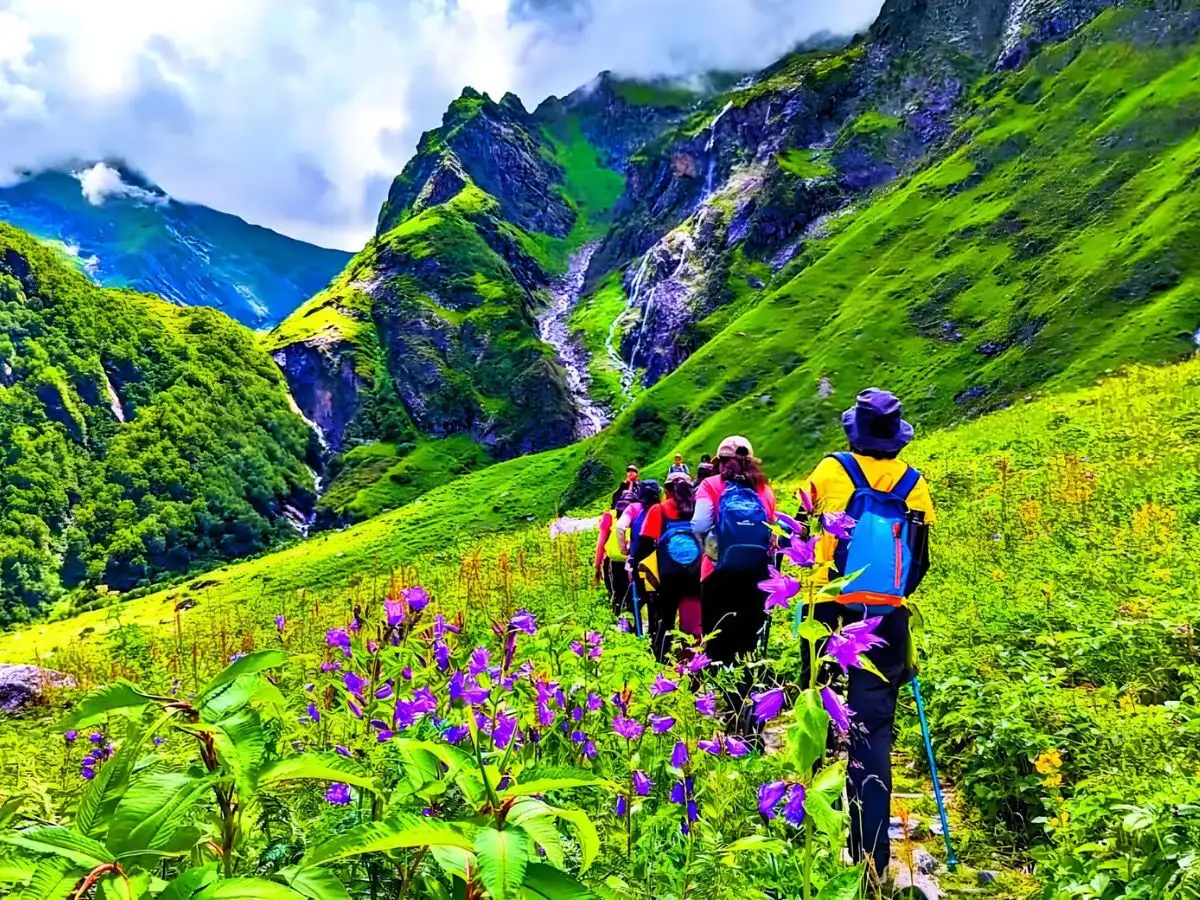
The Valley of Flowers story is closely linked with one of the important early Himalayan mountaineering expeditions.
In 1931, Smythe's party made the first ascent of Kamet, one of the great peaks of the Garhwal Himalaya. Historical records from the Himalayan Club confirm the importance of this expedition and identify Smythe, Shipton and Holdsworth among its prominent members.
Rather than returning entirely along the conventional route, members of the expedition explored other mountain passages.
This brought them into the Bhyundar Valley.
The contrast must have been striking: after spending weeks among rock, snow and high mountain terrain, the climbers entered a much gentler landscape covered with summer vegetation and alpine flowers.
The Valley's reputation began to spread from there.
For the plants and alpine ecosystems that later made the area scientifically important, see our dedicated Valley of Flowers biodiversity and flora guide.
Frank Smythe's Book and the Valley's Growing Fame
Smythe did more than give the landscape a memorable English name.
His writing gave readers a detailed picture of a Himalayan environment that was still extremely remote by the travel standards of the 1930s.
The publication of The Valley of Flowers in 1938 gave the name permanence and attracted further botanical interest.
Over time, the Valley became associated not only with mountaineering history but also with:
- Alpine botany
- Himalayan exploration
- Nature conservation
- Landscape photography
- High-altitude trekking
Its international identity therefore developed gradually rather than through one single “discovery moment”.

Joan Margaret Legge and the Valley's Botanical History
Another important name in the history of Valley of Flowers is Joan Margaret Legge.
Inspired by growing botanical interest in the Valley, Legge travelled there in 1939 to collect and study Himalayan plants.
Historical accounts state that she reached the Valley and began collecting botanical specimens. On 4 July 1939, while working on the slopes near Khulia Garva, she slipped and suffered a fatal fall.
Her death became one of the most poignant chapters in the Valley's documented history.
She was buried in the Valley, and a memorial was later established there. Her grave remains a historical landmark for visitors walking deeper into the protected landscape.
Surviving botanical material associated with Legge also forms part of the scientific legacy of early plant collection in the region.
Because historical accounts differ on the exact institutional arrangements surrounding her expedition, it is better to remember Legge for what is firmly documented: she travelled to the Valley in 1939 for botanical collecting, died there during fieldwork, and became permanently connected with its scientific history.
Mythology of Valley of Flowers
The history of Valley of Flowers cannot be separated completely from mythology.
UNESCO explicitly notes that the Valley has been celebrated in Hindu mythology for much longer than its modern appearance in mountaineering and botanical literature.
The larger Garhwal Himalaya is filled with sacred geography—mountains, rivers, lakes, forests and valleys connected through religious traditions and oral stories.
That cultural landscape is important even when individual legends cannot be treated as verifiable historical events.
Is Valley of Flowers Connected With the Ramayana?
One of the most repeated stories links the wider Himalayan region with Hanuman's search for the Sanjeevani herb in the Ramayana.
Popular local and travel traditions sometimes associate Valley of Flowers with this story because of the extraordinary medicinal and alpine plant diversity of the region.
However, this should be presented as legend rather than geographical fact.
Authoritative UNESCO material confirms the broader association of the landscape with Hindu mythology, but it does not identify Valley of Flowers as the historically verified location where Hanuman found Sanjeevani.
Therefore, a responsible interpretation is:
The Sanjeevani story forms part of the wider mythological imagination surrounding the Himalayas, while the Valley's genuine botanical richness may help explain why this association continues to appeal to visitors.
For actual plant diversity rather than mythology, explore the guide to rare flowers found in Valley of Flowers National Park.
Sacred Geography Around the Valley
Valley of Flowers lies within a part of Uttarakhand where natural landscapes and religious traditions frequently overlap.
Nearby are sacred destinations associated with both Hindu and Sikh traditions.
One of the most important is Hemkund Sahib, reached from the same Ghangaria base used by many Valley of Flowers trekkers.
Rather than covering the religious history of Hemkund Sahib here, travellers combining both destinations can use our dedicated Valley of Flowers with Hemkund Sahib travel guide.
This wider spiritual geography helps explain why travellers often experience the region as something more than a conventional trekking destination.
From Remote Valley to National Park
By the second half of the 20th century, attention increasingly shifted from exploration towards conservation.
Valley of Flowers National Park was established in 1982 and covers approximately 87.5 sq km in Chamoli district, according to the Wildlife Institute of India.
National park status marked an important change in the Valley's history.
The landscape was no longer valued only because it was beautiful or botanically interesting. It became part of India's formal protected-area network.
Protection helped preserve:
- Alpine meadows
- Native vegetation
- Wildlife habitat
- Sensitive high-altitude ecosystems
- Natural ecological processes
For the ecological significance behind that protection, see our detailed Valley of Flowers biodiversity and flora article.
Valley of Flowers and UNESCO World Heritage Status
Another major milestone came in 2005.
Nanda Devi National Park had already been inscribed on the UNESCO World Heritage List in 1988. In 2005, UNESCO approved an extension that added Valley of Flowers National Park, creating the property now known as Nanda Devi and Valley of Flowers National Parks.
UNESCO recognised the Valley for both its extraordinary natural beauty and its internationally important Western Himalayan alpine flora.
The site's history can therefore be viewed through several major stages:
Before 1931: Known within the local and sacred Himalayan landscape
1931: Frank Smythe's expedition brings the Valley into modern mountaineering literature
1938: Smythe's The Valley of Flowers is published
1939: Joan Margaret Legge conducts botanical fieldwork and dies in the Valley
1982: Valley of Flowers becomes a National Park
2005: Added to the UNESCO World Heritage property with Nanda Devi National Park
This progression—from local landscape to exploration story to protected natural heritage—is central to understanding the Valley today.

Why UNESCO Recognition Matters Historically
UNESCO status did not “discover” or create the importance of Valley of Flowers.
Instead, it formally recognised values that had accumulated across several layers of history.
The Valley had already been:
- Part of local Himalayan life
- Connected with sacred traditions
- Described by mountaineers
- Studied by botanists
- Protected as a national park
UNESCO placed these natural values within an international conservation framework.
Its official description even reflects this layered identity by noting that the Valley has been praised by explorers, mountaineers and botanists for more than a century, and in Hindu mythology for much longer.
You can explore the official heritage record on the UNESCO page for Nanda Devi and Valley of Flowers National Parks.
History, Mythology and Fact: Why the Difference Matters
Valley of Flowers attracts stories because it looks like the kind of landscape where stories naturally develop.
But a strong travel guide should distinguish three different types of information.
Documented History
This includes events supported by institutional or historical records, such as:
- The 1931 Kamet expedition
- Frank Smythe's association with the name
- Publication of his book in 1938
- Joan Margaret Legge's 1939 expedition
- National park declaration in 1982
- UNESCO extension in 2005
Oral Tradition and Mythology
These include religious associations and stories passed down through communities.
They are culturally meaningful even when they cannot be verified like modern historical events.
Modern Travel Folklore
Some claims are repeated so frequently online that they begin to look like established history.
This is particularly common with exact locations attached to ancient mythological events.
Responsible travellers should appreciate these stories without automatically treating every modern retelling as historical evidence.
Why Knowing the History Changes the Trek
Many visitors initially come to Valley of Flowers for photographs, trekking and alpine scenery.
Understanding its history adds another dimension.
The trail becomes connected with:
- Early Himalayan mountaineering
- Botanical exploration
- Local knowledge
- Protected-area conservation
- Religious imagination
- International natural heritage
Even the landscape itself begins to feel different when you understand why certain places, names and memorials appear along the route.
For practical planning rather than historical background, use our complete Valley of Flowers travel guide and itinerary.

Frequently Asked Questions
1. Who discovered Valley of Flowers?
Frank S. Smythe and members of his 1931 mountaineering expedition are credited with the Valley's modern discovery and naming. However, local communities knew the region long before the British expedition arrived.
2. When was Valley of Flowers discovered?
Its modern introduction to the wider world dates to 1931, when Smythe's mountaineering party entered the Bhyundar Valley after the Kamet expedition.
3. Why is it called Valley of Flowers?
Smythe and his companions encountered extensive alpine meadows filled with flowers and remembered the Bhyundar landscape as the “Valley of Flowers”. The name later became widely known through Smythe's writing.
4. Who was Joan Margaret Legge?
Joan Margaret Legge was a botanist who travelled to Valley of Flowers in 1939 to collect plant specimens. She died after a fall while conducting fieldwork, and a memorial grave remains associated with her in the Valley.
5. Is Valley of Flowers connected with Hindu mythology?
Yes. UNESCO specifically recognises that the landscape has been celebrated in Hindu mythology for much longer than its documented modern mountaineering history.
6. Did Hanuman find Sanjeevani in Valley of Flowers?
Popular traditions sometimes connect the region with Hanuman's search for Sanjeevani, but this should be understood as mythology rather than a historically verified location claim.
7. When did Valley of Flowers become a National Park?
Valley of Flowers National Park was established in 1982 in Chamoli district of Uttarakhand.
8. When did Valley of Flowers become a UNESCO World Heritage Site?
Valley of Flowers was added in 2005 as an extension to the existing Nanda Devi World Heritage property. The combined property is now called Nanda Devi and Valley of Flowers National Parks.
Final Thoughts
The history of Valley of Flowers is not a simple story of a British explorer suddenly finding an unknown Himalayan valley.
It is far richer than that.
Local communities knew the landscape before modern mountaineers arrived. Himalayan mythology had already given the wider region spiritual meaning. Frank Smythe and his companions brought the Valley to international attention in 1931, while later botanical exploration expanded scientific interest.
National park status in 1982 and UNESCO recognition in 2005 eventually transformed the Valley into one of India's most internationally recognised protected Himalayan landscapes.
Today, visitors walk through a landscape shaped simultaneously by nature, local memory, exploration, mythology, science and conservation.
Knowing that history makes Valley of Flowers much more than a beautiful meadow—it turns the trek into a journey through nearly a century of documented Himalayan exploration and a much older cultural relationship with the mountains.


